Needle Holder Uses, Types, and Diagram: Complete Surgical Guide

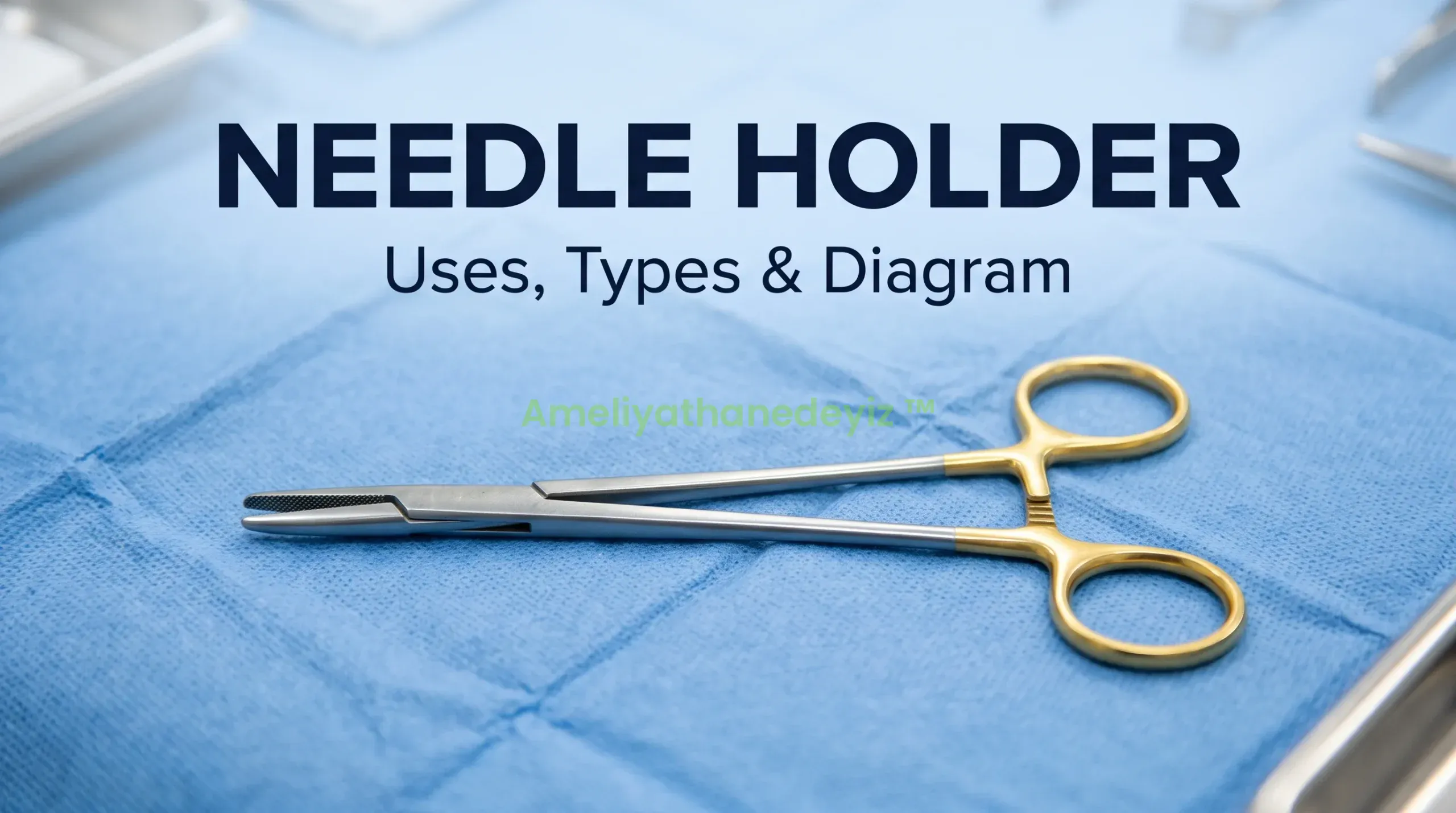
A needle holder—also called a needle driver, needle forceps, or suture holder—is an essential hinged surgical instrument engineered to grasp and guide curved suturing needles through tissue during wound closure and anastomosis. Unlike standard hemostats designed for soft tissue, a needle holder features short, heavy-duty jaws with cross-hatched serrations that lock rigid stainless-steel needles securely in place without slipping or twisting.
Whether you are studying surgical instrumentation for nursing or scrub tech exams, or preparing a Mayo stand for general surgery, understanding the labeled parts, primary uses, and major types of needle holders is critical for operating room safety and efficiency.
Needle Holder Uses: Primary Functions in the Operating Room
The primary purpose of a needle holder is to provide controlled mechanical leverage when driving a curved needle through anatomical layers. Its core clinical uses include:
Grasping and Driving Suture Needles: Firmly holding curved needles (such as 3/8-circle or 1/2-circle needles) so the surgeon can penetrate skin, fascia, muscle, or blood vessels with precision.
Instrument Knot Tying: Serving as a steady anchor when performing two-handed or one-handed instrument ties in deep body cavities where fingers cannot easily reach.
Controlling Needle Angle and Torque: Preventing needle rotation during delicate suturing (such as vascular or subcuticular closures), reducing unnecessary tissue trauma.
Protecting Surgeon Safety: Eliminating the need to handle sharp suture needles directly with gloved fingers, significantly reducing needlestick injuries.
Scrub Tech Golden Rule: Clamp the suture needle approximately one-third to one-half of the distance from the swaged (thread) end using the tip of the needle holder jaws. Never clamp directly on the swaged area (which weakens the needle-thread junction) or on the sharp cutting point (which dulls the tip).
Needle Holder Diagram and Labeled Parts
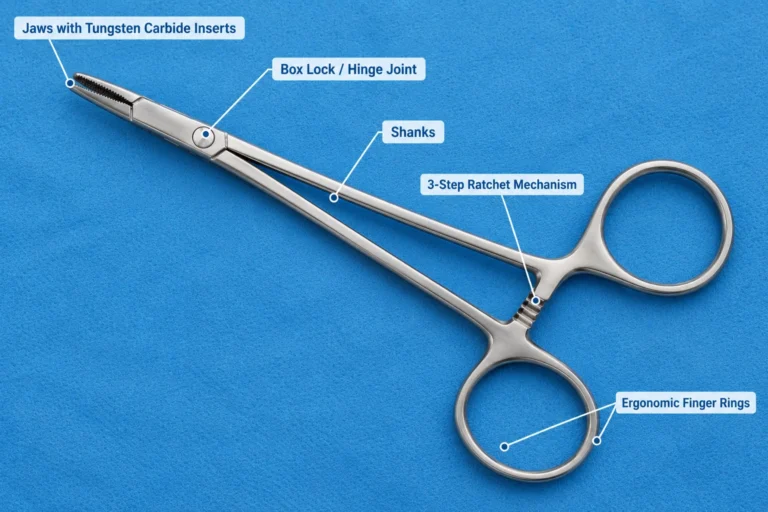
Understanding the anatomy of a surgical needle holder helps you inspect instruments for wear before sterilization and pass them accurately on the sterile field.
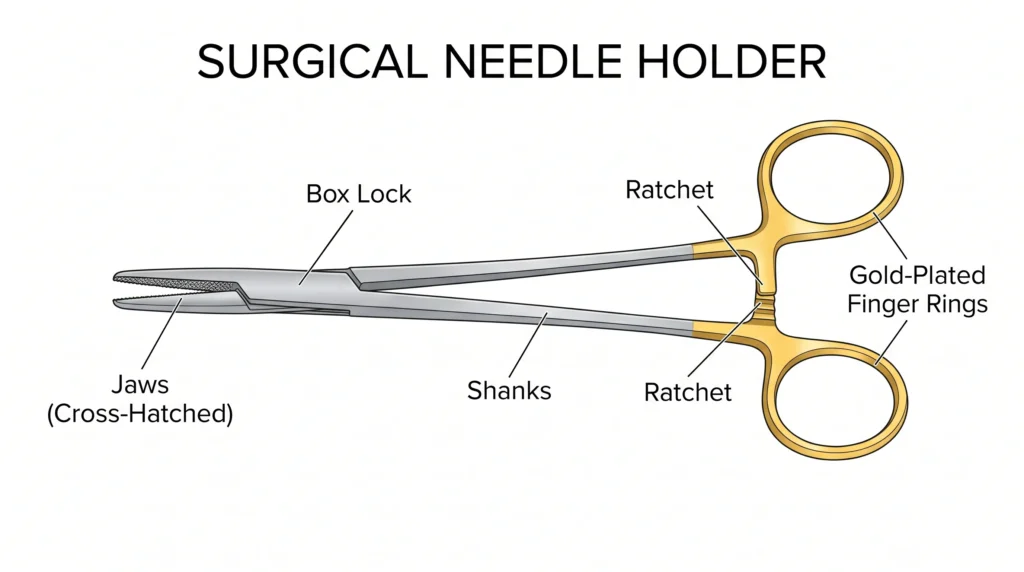
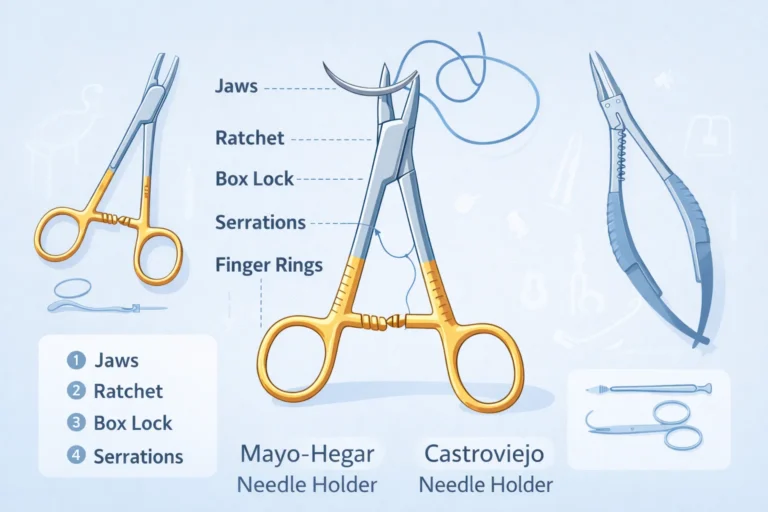
Labeled Parts and Functions Breakdown
| Labeled Part | Anatomical Location | Primary Function |
| Jaws (Beaks) | Distal working tip | Short, blunt, and sturdy tips that grip the metal needle. Inner surfaces feature cross-hatched (criss-cross) serrations and often a central longitudinal groove to seat the needle. |
| Tungsten Carbide (TC) Inserts | Bonded to inner jaw faces | Ultra-hard alloy inserts that prevent needle slippage and extend instrument lifespan. Identified externally by gold-plated finger rings. |
| Box Lock (Joint) | Pivot point between jaws and shanks | Hinged fulcrum transferring hand pressure into high-torque gripping force at the tip. Must be checked regularly for hairline cracks. |
| Shanks (Shafts) | Long body arms between joint and rings | Longer than hemostat shanks to maximize mechanical leverage and allow deep-cavity access. |
| Ratchet Mechanism | Interlocking teeth near the finger rings | Locks the jaws closed at adjustable tension levels so the surgeon does not have to maintain constant squeeze pressure while suturing. |
| Finger Rings | Proximal handles (or spring handles) | Ergonomic loops for the thumb and ring finger (with the index finger extended along the shank for stability). |
Types of Surgical Needle Holders
Different surgical specialties require specific jaw widths, handle lengths, and locking mechanisms depending on needle size and tissue depth.
| Needle Holder Type | Handle & Design Feature | Recommended Needle / Suture Size | Primary Surgical Specialties |
| Mayo-Hegar Needle Holder | Classic ring handles with ratchet; broad, heavy cross-hatched jaws | Medium to heavy needles (2-0 to #2) | General surgery, orthopedics, OB/GYN, fascia & skin closure |
| Olsen-Hegar Needle Holder | Ring handles with ratchet + built-in suture scissors behind the jaws | Medium needles (3-0 to 0) | Emergency medicine, minor procedures, single-operator suturing |
| Derf Needle Holder | Short, compact ring handles with fine, smooth-edged cross-hatched jaws | Small, delicate needles (5-0 to 3-0) | Plastic surgery, dental/oral surgery, facial lacerations |
| Mathieu Needle Holder | Palm-grip curved handles with a squeeze-to-release spring ratchet | Small to medium needles (4-0 to 2-0) | Podiatry, hand surgery, rapid continuous suturing |
| Castroviejo Needle Holder | Spring-action pencil grip with a thumb-activated catch lock; ultra-fine tips | Micro-needles (6-0 to 10-0) | Ophthalmology, microsurgery, vascular & neurosurgery |
| Ryder Needle Holder | Long, slender shanks with narrow, finely tapered jaws | Fine vascular needles (5-0 to 7-0) | Cardiovascular, thoracic, and peripheral vascular surgery |
What Do Gold Handles Mean on a Needle Holder?
If you spot a needle holder with gold-plated finger rings on the instrument tray, it indicates that the jaws are lined with tungsten carbide (TC) inserts. Tungsten carbide is significantly harder than standard surgical stainless steel, giving the jaws superior grip on smooth suture needles and preventing premature flattening of the cross-hatched pattern.
Needle Holder vs. Artery Forceps (Hemostat)
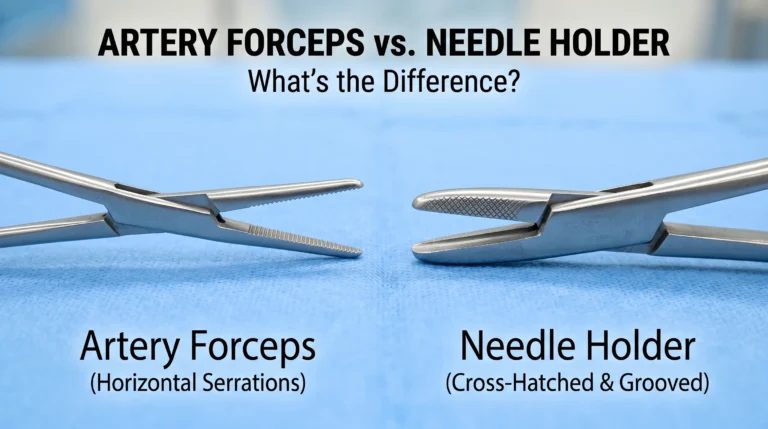
A frequent exam question and operating room pitfall is confusing a needle holder with an artery forceps (hemostat). While both have ring handles and ratchets, artery forceps have longer, thinner jaws with horizontal serrations meant for clamping soft blood vessels, whereas needle holders have shorter, thicker jaws with cross-hatched serrations built for rigid metal needles.
For a side-by-side jaw comparison and exam checklist, read our detailed breakdown: Difference Between Artery Forceps and Needle Holder.
Frequently Asked Questions (FAQ)
What is a needle holder also called?
A needle holder is commonly referred to as a needle driver, needle forceps, or suture holder. In European and Turkish operating rooms, it is also widely known by its French-derived name, portegü (porte-aiguille).
What are the main parts of a needle holder?
From tip to handle, the six primary parts of a standard needle holder are the jaws (beaks), tungsten carbide inserts (if present), box lock (joint), shanks, ratchet mechanism, and finger rings.
Which needle holder is most commonly used in general surgery?
The Mayo-Hegar needle holder is the standard workhorse in general surgery due to its balanced weight, versatile jaw width, and strong ratchet lock suitable for most medium-to-heavy suture needles.
How do you match needle size to the right needle holder?
Match the jaw width to the needle thickness: use fine-tipped holders (Castroviejo, Derf, Ryder) for small needles (5-0 and smaller) to avoid bending the needle, and heavy-duty holders (Mayo-Hegar) for thick needles (2-0 and larger) so the needle does not twist inside the jaws.
References and Further Reading
Association of Surgical Technologists (AST): Standards of Practice for the Care and Handling of Surgical Instruments.
Association of periOperative Registered Nurses (AORN): Guidelines for Perioperative Practice — Instrument Care and Cleaning.
Tighe, S. M.: Instrumentation for the Operating Room: A Photographic Manual (Elsevier).
Educational & Medical Disclaimer
The content provided on ameliyathanedeyiz.com is strictly for educational and informational purposes, designed to assist nursing students, medical trainees, and surgical technologists in their academic studies. It does not replace formal clinical supervision, institutional sterilization policies, or the direct instructions of an attending surgeon.
 Tepki Ver