Difference Between Artery Forceps and Needle Holder: A Complete Guide

Whether you are a nursing student, a surgical technologist in training, or a junior doctor, stepping into the operating room (OR) for the first time can be overwhelming. Among the hundreds of surgical instruments on the Mayo stand, two of the most commonly confused tools are the artery forceps (hemostat) and the needle holder (needle driver).
To the untrained eye, their scissor-like handles and ratchets look almost identical. However, mixing them up during surgery is a critical error that can damage expensive equipment and compromise patient safety.
In this comprehensive guide, we will break down the anatomical and functional differences between an artery forceps and a needle holder, how to identify them instantly, and why you should never use one in place of the other.
What is an Artery Forceps (Hemostat)?
An artery forceps, commonly referred to as a hemostat (e.g., Kelly clamp, Crile forceps, or Mosquito), is a surgical instrument primarily designed for hemostasis—the arrest of bleeding.
Key Characteristics:
Primary Function: Clamping blood vessels, holding delicate tissues, or tying off bleeding points.
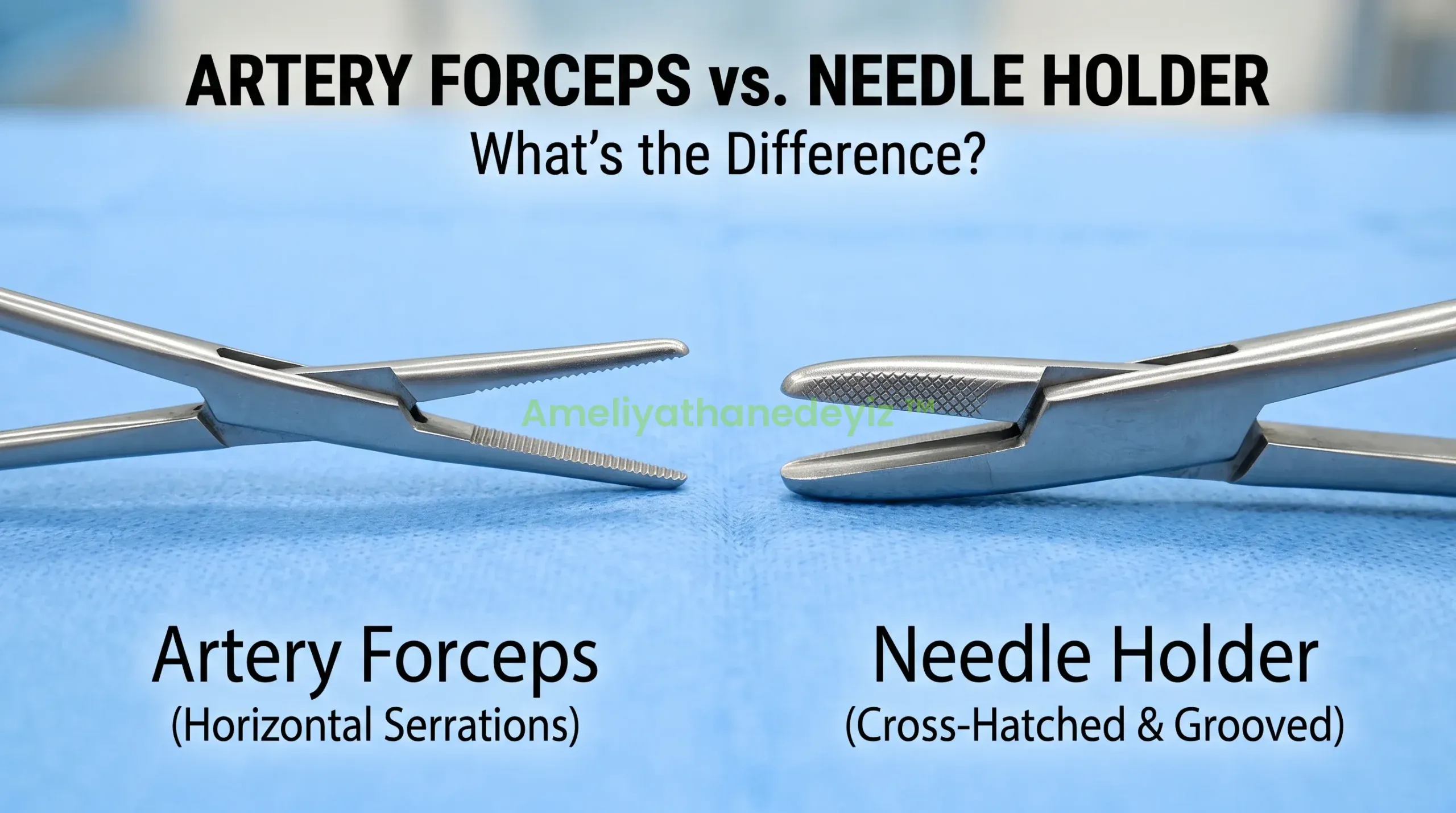
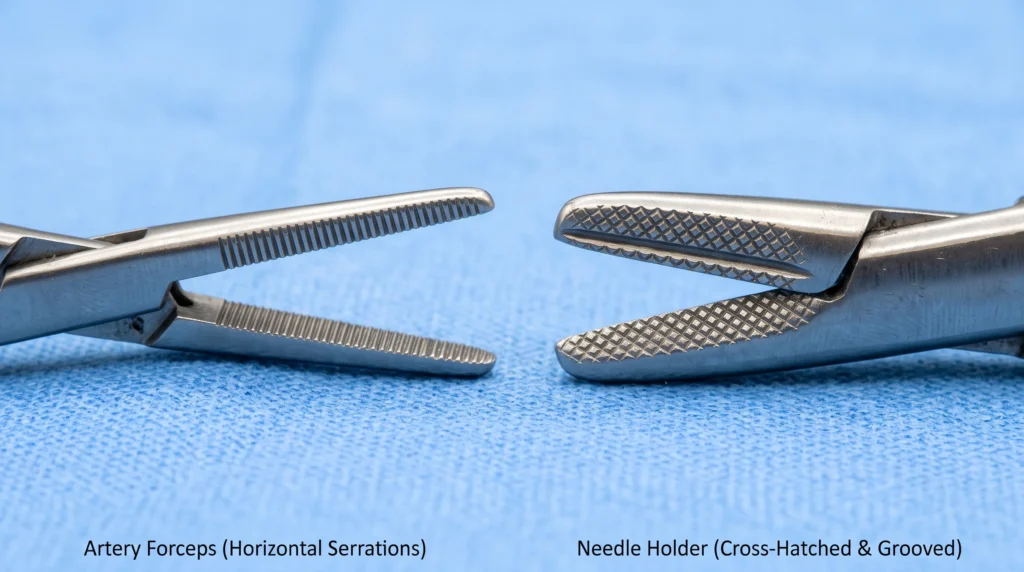
Jaw Design: The inner surface of the jaws features horizontal (transverse) serrations. These serrations may run along the entire length of the jaw (like a Crile) or only halfway (like a Kelly). These parallel ridges are designed to grip soft tissue firmly without crushing it.
Build Profile: Generally lighter and slimmer with longer, more delicate jaws compared to a needle holder.
What is a Needle Holder (Needle Driver)?
A needle holder (such as the Mayo-Hegar or Mathieu) is a heavy-duty surgical instrument explicitly engineered to grasp and drive curved suturing needles through tissue.
Key Characteristics:
Primary Function: Securely gripping hard metal suture needles and tying surgical knots.
Jaw Design: The inner surface of the jaws features a cross-hatched (criss-cross) pattern. Most modern needle holders also have a central longitudinal groove (a slight depression in the middle of the jaw) to lock the needle in place and prevent it from rotating while suturing.
Build Profile: Designed for strength. The jaws are typically shorter, thicker, and much sturdier than those of a hemostat to withstand the force of driving a needle through tough tissue.
Quick Comparison Table: Artery Forceps vs. Needle Holder
This table highlights the exact differences you need to know to pass your OR exams and assist your surgeon flawlessly:
| Feature | Artery Forceps (Hemostat) | Needle Holder (Needle Driver) |
| Primary Use | Clamping blood vessels and soft tissues | Holding suture needles and tying knots |
| Jaw Inner Surface | Horizontal (transverse) serrations | Cross-hatched (criss-cross) pattern |
| Central Groove | Absent (smooth continuous serrations) | Present (usually has a groove to seat the needle) |
| Blade / Jaw Shape | Longer, slimmer, and more delicate | Shorter, thicker, broader, and sturdier |
| Handle to Blade Ratio | Blades are relatively long compared to handles | Handles are much longer than the short, stubby blades |
| Target Material | Soft biological tissue | Hard metal (stainless steel needles) |
Why Mixing Them Up is a Costly Mistake
A very common mistake made by beginners is grabbing a hemostat to hold a needle when a needle holder isn’t immediately available. Never do this.
Artery forceps are designed to hold soft, compressible human tissue. Suture needles are made of rigid stainless steel. If you use a hemostat to grip a needle, the hard metal will flatten the delicate horizontal serrations, misalign the jaws, and permanently spring the hinge. The next time a surgeon tries to use that damaged hemostat to stop a bleeding artery, the vessel will slip right through, putting the patient at severe risk.
Golden Rule of the OR: Only metal touches metal. Use a needle holder for needles, and keep your hemostats for tissues.
Frequently Asked Questions (FAQ)
While a needle holder is strong enough to clamp tissue, its cross-hatched jaws can severely crush and traumatize soft tissues. It should only be used for its intended purpose (needles) or grasping heavy, to-be-discarded tissue.
The Mayo-Hegar needle holder is the most widely used needle driver in general surgery. It lacks cutting blades (unlike the Olsen-Hegar, which has built-in scissors) and provides excellent grip.
Look at the tips! If the working end (the beak) is short, thick, and looks tough, it’s a needle holder. If the beak is long, slender, and delicate, it’s a hemostat.
📌 References and Further Reading
Association of Surgical Technologists (AST): Standards of Practice for the Care and Handling of Surgical Instruments.
World Health Organization (WHO): Safe Surgery Saves Lives Guidelines & Surgical Safety Checklist.
Tighe, S. M.: Instrumentation for the Operating Room: A Photographic Manual (Standard educational reference for scrub technologists).
⚠️ Educational & Medical Disclaimer
The content provided on ameliyathanedeyiz.com is strictly for educational and informational purposes, designed to assist medical students, nursing professionals, and surgical technologists in their academic learning. It is not a substitute for formal clinical training, professional medical advice, or certified surgical protocols. Always adhere to your hospital’s specific operating room guidelines, sterilization standards, and the direct instructions of your attending surgeon.
 Tepki Ver