🧠 What Does Pathological Meaning? Definition in Medicine, Psychology, and Real-Life Terms

You’ve probably heard the term “pathological meaning” tossed around—maybe in a hospital, a psychology class, or even a courtroom. But what does it really mean?
Whether you’re studying medicine, exploring mental health, or just want to understand how this powerful word is used in context, you’ve landed in the right place. Let’s break it down in simple terms. 🧬
Other term https://ameliyathanedeyiz.com/en/category/do-you-know-these/
📘 What Does “Pathological” Meaning in Simple Terms?
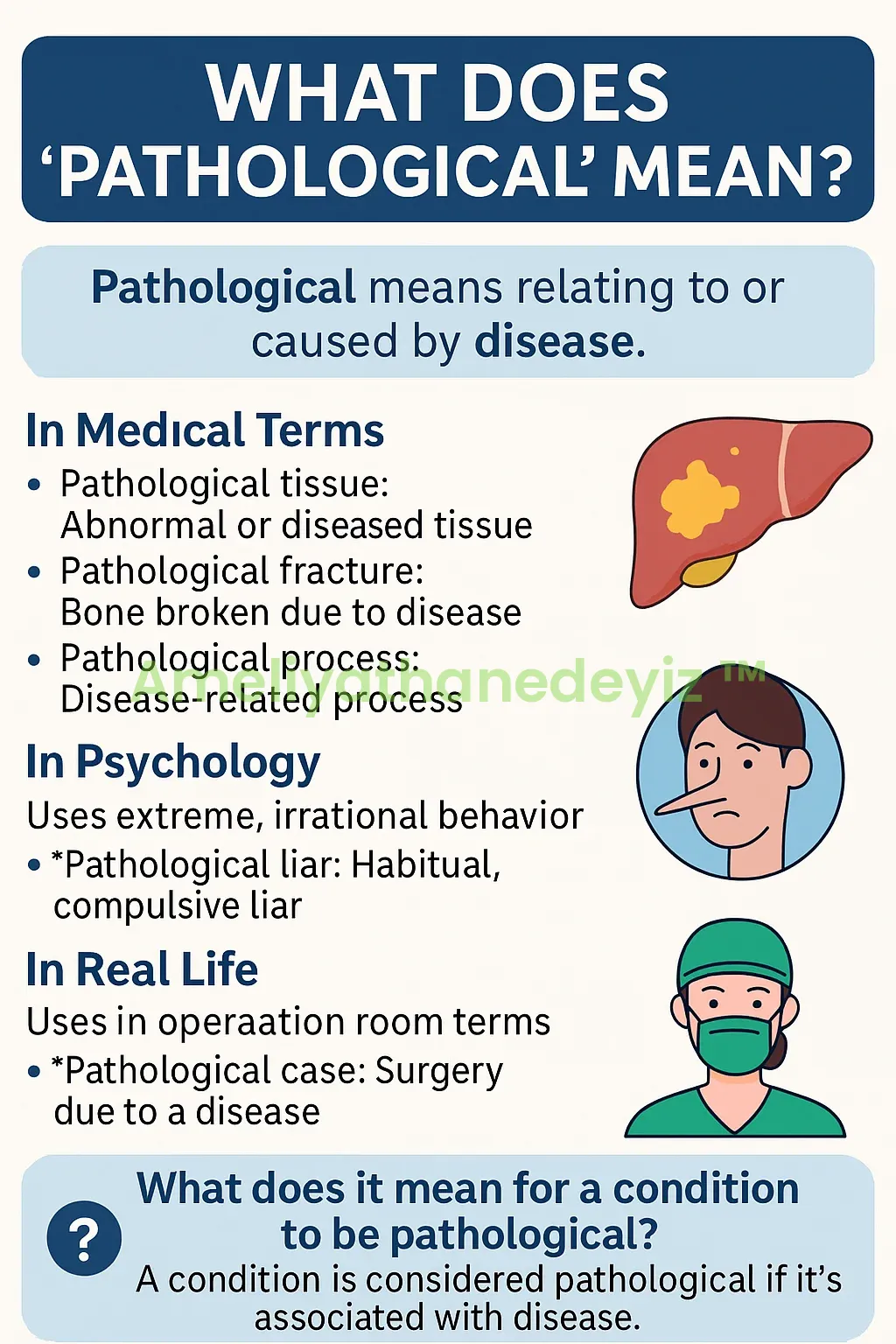
In its simplest form, pathological means: “relating to disease.”
In other words, when something is described as pathological, it is abnormal or caused by a medical or psychological condition. The term comes from the Greek word pathos, meaning “suffering” or “disease.”
🏥 What Does Pathological Meaning in Medical Terms?
In medical language, pathological refers to diseased tissues, conditions, or processes. It’s often used in diagnoses, reports, and pathology labs.
🔬 Common Uses:
| Phrase | Meaning |
|---|---|
| Pathological tissue | Tissue that shows disease under a microscope |
| Pathological fracture | A bone break caused by disease (e.g., cancer), not trauma |
| Pathological process | Any abnormal biological mechanism (e.g., inflammation, tumor) |
💡 Example in a sentence:
“The biopsy confirmed a pathological change in the liver tissue.”
🧠 What Does Pathological Meaning in Psychology?
In psychology, the word takes on a more behavioral meaning. It describes patterns of behavior that are obsessive, irrational, or unhealthy.
| Psychological Use | What It Means |
|---|---|
| Pathological liar | Someone who lies compulsively and uncontrollably |
| Pathological behavior | Actions that are extreme and driven by mental illness |
| Pathological fear | An irrational, debilitating fear |
💬 Example: “Her fear of germs became pathological and disrupted her daily life.”
🛏️ What Does a Pathological Case Mean in a Hospital or OR?
In clinical and operating room (OR) settings, a “pathological case” usually refers to a surgery or procedure related to a disease process—like removing a tumor, performing a biopsy, or treating infected tissue.
| Term | Meaning in OR/Clinic |
|---|---|
| Pathological specimen | Tissue sent to pathology lab for examination |
| Pathological case | A patient whose condition is due to a disease |
| Non-pathological case | Cosmetic or elective surgery not disease-related |
📚 Anatomy and Pathology: How Are They Linked?
Anatomy is the study of normal body structures, while pathology is the study of abnormal (diseased) structures.
| Field | Focus |
|---|---|
| Anatomy | Normal organs/tissues |
| Pathology | Diseased organs/tissues |
Pathological anatomy is the bridge between anatomy and disease.
❓ Frequently Asked Questions
Typically, yes—it implies something abnormal or harmful, either physically or psychologically.
Yes. When emotions (like sadness or anger) are extreme, irrational, and disruptive, they can be labeled pathological in psychology.
🧾 Real-Life Examples
“My mom’s mole turned out to be pathological. Thankfully, they caught the melanoma early.”
— Mike, California
“He’s not just a liar, he’s a pathological one. He believes his own lies.”
— Dr. Adams, Clinical Psychologist
📚 Sources
MedlinePlus: Medical Terminology
Mayo Clinic Pathology Reports
Johns Hopkins Medicine – Pathology Overview
 Tepki Ver